Changeover from thirty minutes to five
A manual stapling operation could not hold a monthly demand target, because the cycle time moved with whoever was running it. TMD automated the process around the stapler head the operators were already using — and left the line faster to change over than it had ever been to run.




- Changeover
- 30 → 5 min
- Staples
- 12 / min
- Recipes
- 1,000
Time to switch the machine over to a new product, cut by six times.
Sustained rate, with up to eight staple locations on a fixture plate.
Configurable per fixture plate and selectable by the operator from the HMI.
A rate nobody could plan against
The client needed more output to meet a monthly demand target, and the constraint was not the stapler — it was the hand process around it. Cycle time varied with the operator, so the line could be quick one shift and short the next, and neither the rate nor the changeover could be planned against.
They wanted the staples applied automatically and the throughput controlled, without throwing away the tooling and technique the operation already ran on.
Automated around the tool they already had
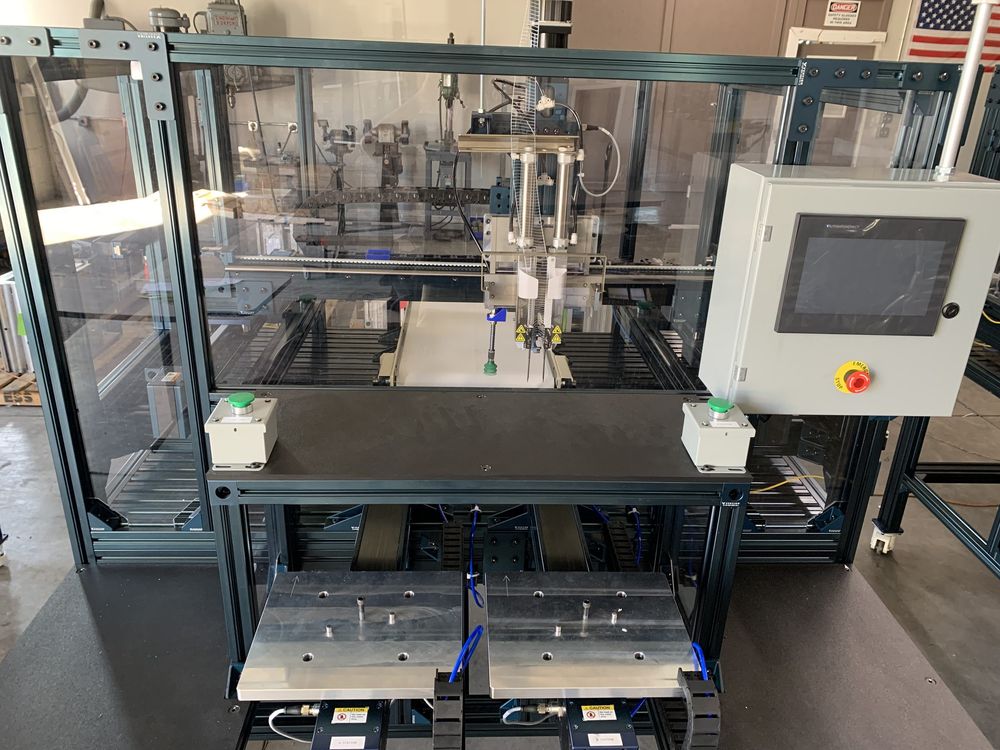
TMD studied the existing manual process first and designed the machine around it, rather than designing a machine and asking the floor to adapt. The result is a 6-axis machine that takes the same elastic stapler head the operators had been using by hand and drives it on a gantry.
Two indexing infeed stages present the work; a 4-axis XYZ gantry positions the head; pneumatic vacuum pickup and cylinder controls hold and place the part; an outfeed belt conveyor moves it on. The frame and motion hardware are Vention; the controls are TMD.
Throughput the plant sets
What changed on the floor, and why the changeover figure is the one that mattered most.
Throughput became something the plant sets rather than something it discovers at the end of a shift, and a run of manual handling — moving fixture plates between stations, placing each staple by hand — came out of the process entirely.
The changeover result is the one that changed how the line is scheduled. Thirty minutes to five means a short run stops being an expensive decision, so the client can chase smaller orders that previously were not worth the downtime.
The machine is not single-purpose. Recipes are taught from the HMI with setup screens TMD wrote for the job, and the same hardware runs any elastic stapling application — or straightforward pick-and-place, if the work changes.
This machine is beautiful. We love the quality of work TMD put into this machine and the Vention blue looks sharp!
The client, quoted in Vention's write-up. Unnamed, as a matter of policy.
Who did what
Worth separating, because "built with Vention hardware" and "built by Vention" are not the same sentence.
TMD designed, built and programmed
- Process study of the existing manual operation, and the machine designed around it
- Custom control panel, designed and built in-house
- PLC and HMI programming, including the recipe and teaching screens
- Integration of the client’s existing elastic stapler head into the automated system
- Build, commissioning and hand-off
Vention supplied
- Enclosed timing belt and ball screw actuators
- Extrusions
- Conveyor
We don't name customers. Not on this page and not on any other — what you automate, and when, is your business and your competitors' curiosity. The figures above are checkable at the source, which is what a case study actually has to prove.
What this job drew on
Robot integration & programming
A cell that holds rate on the part you actually run — palletizing bags and boxes, machine tending, grinding, inspection. Scoped, built, programmed and commissioned by one shop, so there is no integrator-to-fabricator gap to manage.
Read more →Control panel fabrication
Enclosure design, layout, wiring and assembly done in-house to UL 508A — not subbed out. The people building the panel are the people writing the code that runs it, which is why the drawings still match the panel a year later.
Read more →